
The sweet story behind the scoop

History of Ice Cream

Ice cream did not appear in one glorious lightning bolt of vanilla. It was assembled slowly, deliciously, and sometimes messily through ice harvesting, royal kitchens, street carts, immigrant ingenuity, dairy science, soda fountains, home freezers, and generations of people who looked at a bowl of cream and thought: what if this were colder?

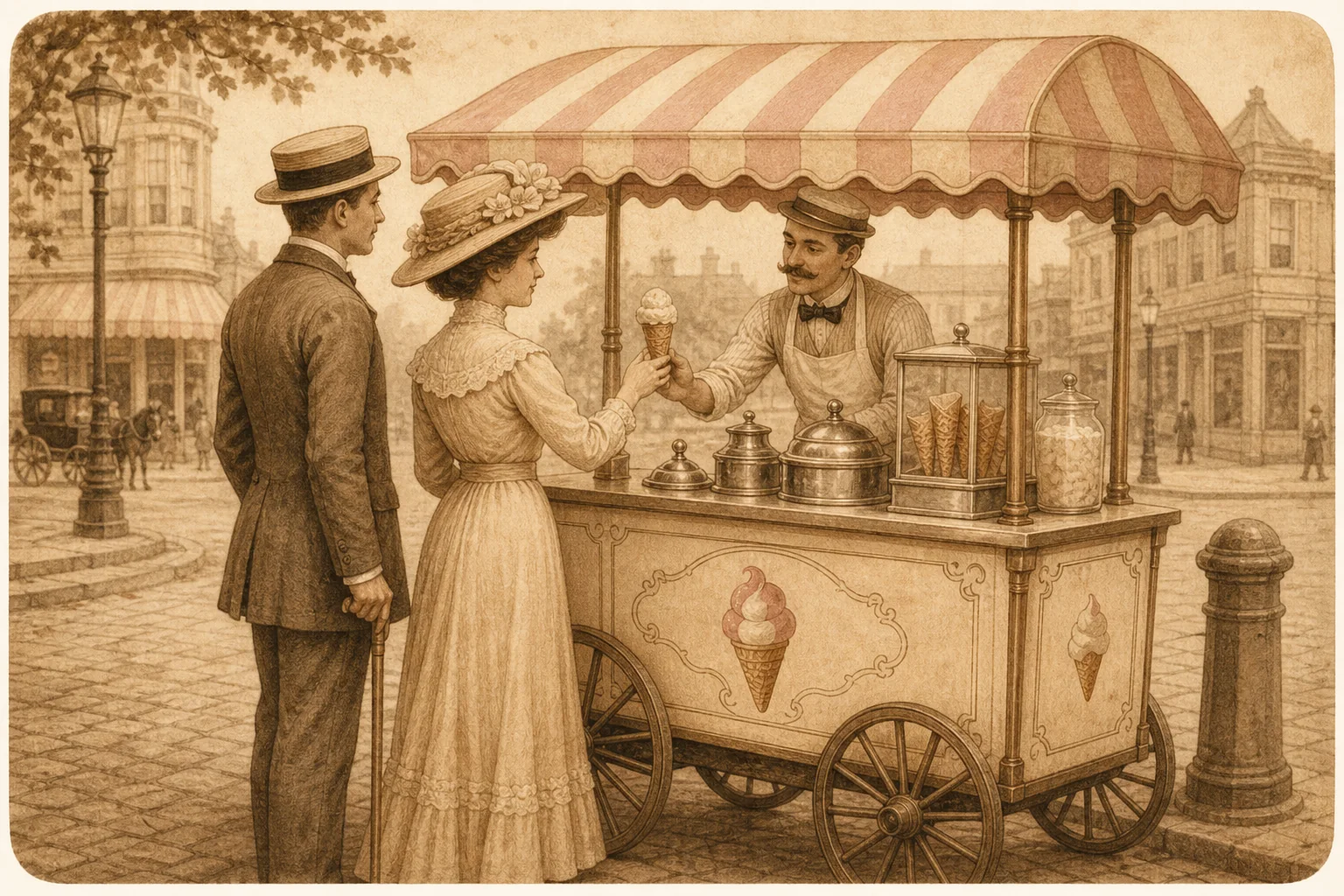
Vintage ice cream cart with customers
From snow bowls to scoop shops

So, who invented ice cream?

The honest answer: everyone, slowly.

There is no single inventor of ice cream. The dessert we now recognize as ice cream is the result of many separate breakthroughs: people learned to flavor snow and ice, sweeten fruit syrups, chill dairy, freeze custards with ice and salt, churn mixtures smooth, move ice across long distances, manufacture freezers, and eventually keep a pint in the kitchen without needing a cellar full of winter.

That is what makes ice cream history so entertaining. It is not a tidy origin story. It is a relay race: ancient flavored ices hand the baton to sherbets, sherbets to milk ices, milk ices to cream desserts, cream desserts to hand-cranked freezers, freezers to soda fountains, cones, trucks, soft serve, supermarket pints, and tiny shops inventing flavors faster than a menu board can keep up.
A rich, chilly timeline

From Ancient Ices to the Freezer Aisle

Dates in food history are often slippery. Recipes travel, tools change, and good ideas get reinvented in more than one kitchen. This timeline focuses on the big turning points that shaped ice cream as we know it.

Ancient

Snow, ice, fruit, honey, and status

Long before modern ice cream, people in several regions enjoyed chilled mixtures made with snow or ice. Some famous stories involve rulers sending servants for mountain snow, but the bigger point is simpler: cold sweets were impressive because cold itself was hard to get.

Early

Milk ices and frozen dairy ancestors

Early milk-based frozen desserts appear in different forms across Asia and the Middle East. These were not modern American ice cream, but they helped prove that dairy, sweetness, and cold could become something luxurious.

Medieval

Sherbet, sharbat, and syrupy sophistication

Sweetened drinks and chilled fruit syrups traveled through trade routes, court kitchens, and medical traditions. Words such as sherbet and sorbet carry traces of this long exchange between flavor, refreshment, and frozen technique.

1600s

European court desserts get colder and creamier

By the 17th century, French and Italian cooks were developing recipes for ices and cream-based frozen desserts. These were elite luxuries, served where sugar, dairy, skilled labor, and stored ice could meet at the same expensive table.

1700s

Ice cream enters colonial American records

Ice cream was served in the American colonies by the mid-1700s. It was still a special-occasion dessert, usually tied to households with money, servants, ice storage, imported tools, and enough patience to turn a hot day into a cold course.

1780s

Jefferson's recipe and Washington's equipment

Thomas Jefferson did not introduce ice cream to America, but his surviving recipe is an important early American record. George Washington's Mount Vernon accounts also show specialized equipment and serving pieces for ice cream in the late 1700s.

1843

The hand-cranked freezer changes home dessert

Nancy Johnson's hand-cranked ice cream freezer helped turn ice cream making into a more practical household project. You still needed ice, salt, ingredients, and arm power, but the result was smoother and more repeatable.

1851

Commercial production scales up

Baltimore dairyman Jacob Fussell is widely associated with early large-scale American ice cream production. Once ice cream could be made in larger quantities and shipped more reliably, it began moving from elite novelty toward everyday treat.

Late 1800s

Soda fountains become social theaters

Pharmacies, fountains, and confectionery shops gave ice cream a stage. This was where sundaes, sodas, floats, and counter culture grew up, complete with tall glasses, chrome fixtures, and the tiny drama of choosing a syrup.

1904

The cone becomes a national celebrity

The edible cone was not born from a single undisputed moment, but the 1904 St. Louis World's Fair helped make it famous in the United States. After that, portable ice cream had a perfect outfit.

1900s

Trucks, bars, soft serve, and supermarket pints

Mechanical refrigeration, continuous freezers, packaged novelties, curbside vendors, and home freezers made ice cream easier to manufacture, distribute, store, and crave at inconvenient hours.

Today

The modern scoop is global, local, and wildly inventive

Today, ice cream history lives in gelato cases, kulfi molds, mochi wrappers, paleta carts, rolled ice cream shops, soft-serve windows, vegan pints, farmer's market flavors, and neighborhood scoop shops with chalkboard menus.

Before there were scoops

Early Frozen Desserts: Cold Was the Luxury

Ice was once the headline ingredient

Today we tend to focus on flavor: chocolate, vanilla, strawberry, pistachio, mango, mint chip. In much of early dessert history, the most impressive ingredient was the cold itself. Before electric refrigeration, ice had to be harvested in winter, packed in straw or sawdust, stored in ice houses, guarded against melt, and carried into kitchens at just the right moment.

That made frozen treats perfect for power moves. Serving a chilled dessert in warm weather said, without saying it, "Look what this household can command: labor, storage, timing, trade, sugar, fruit, dairy, and a small miracle of temperature."

Ancient stories are tasty, but not always tidy

Ice cream origin stories often name emperors, conquerors, or travelers because history likes a main character. Some tales describe snow flavored with honey, fruit, wine, or nectar. Others describe chilled dairy mixtures from court kitchens. These stories are useful as clues, but they should not be confused with a recipe for a modern scoop.

The safest way to understand the beginning is this: many cultures discovered that cold plus sweetness was irresistible. The exact path from flavored snow to churned ice cream took centuries.

The syrup route

Sherbet, Sorbet, and the Road to Cream

Before cream became the star, fruit ices and syrupy drinks helped shape the frozen dessert family tree. The words sherbet and sorbet point toward older traditions of sweetened, flavored refreshments. As sugar became more available to European cooks and freezing methods improved, flavored ices became more elaborate.

Then came the creamy twist. Once cooks began combining dairy, eggs, sugar, flavorings, and controlled freezing, the dessert moved closer to what we would recognize as ice cream. It still took serious work: a container of mixture surrounded by ice and salt, regular turning or scraping, and a cook patient enough to keep the texture from becoming a sweet brick.

Why salt mattered

Salt lowers the freezing point of ice water. In an old-fashioned freezer, that salt-and-ice bath could get cold enough to freeze a sweet dairy mixture while stirring kept ice crystals small. Translation: chemistry did the chilling, human arms did the smoothing.

Read the science of smooth ice cream

America gets a taste

From Presidential Tables to Parlor Counters

Ice cream in elite households

In the 1700s, American ice cream was not a casual weeknight spoon-and-carton situation. It required ice storage, specialized containers, servants or cooks, and imported or expensive ingredients. That made it a showpiece at dinners and receptions.

Jefferson's famous recipe

Thomas Jefferson's handwritten vanilla ice cream recipe is one of the best-known early American ice cream documents. It is also a good reminder that Jefferson popularized ice cream among elite guests but did not single-handedly introduce it to the country.

Washington's ice cream tools

Mount Vernon records show George Washington's household purchased a "Cream Machine for Ice" in 1784 and later acquired molds, serving pieces, and pots. In other words, early American ice cream had accessories.

Recipes spread

As cookbooks and manuscript recipe collections included more frozen desserts, ice cream knowledge moved beyond a few fashionable tables. Each recipe helped turn a luxury into a craft people could imitate.

The hand-crank era

The crank freezer made home ice cream more realistic. It also created a ritual: someone turned, someone packed the ice, someone sneaked a spoonful too early, and everyone pretended they were helping equally.

Wholesale changes everything

Commercial production lowered the barrier between "a dessert for special households" and "a dessert ordinary people could buy." Ice cream became less of a palace trick and more of a city pleasure.

The golden age of going out for a scoop

Parlors, Soda Fountains, Sundaes, and Cones

Soda fountains made ice cream sociable

Ice cream did not become iconic only because it tasted good. It became iconic because people had places to eat it. The soda fountain and ice cream parlor gave frozen desserts architecture, atmosphere, and ritual: counters, stools, glass dishes, syrup pumps, uniforms, menu boards, first dates, family outings, after-school stops, and the magnificent pressure of deciding between a float and a sundae.

These spaces also encouraged invention. Once ice cream sat beside carbonated water, syrups, fruit, nuts, whipped cream, and chocolate sauce, the menu started multiplying. Ice cream sodas, sundaes, banana splits, milkshakes, floats, and malts all belong to this highly sociable branch of the family tree.

Explore classic ice cream desserts

Illustrated old-fashioned ice cream cart

Rolling into the neighborhood

Ice Cream Trucks Made the Treat Mobile

Once ice cream could be frozen, packaged, and transported more reliably, it no longer had to wait inside a parlor. Trucks and carts brought frozen treats to sidewalks, beaches, fairs, parks, and neighborhoods. The experience was part dessert and part chase scene: hear the music, find the change, run before the truck turns the corner.

That mobility changed the emotional flavor of ice cream. A cone from a parlor was an outing. A bar from a truck was a small ambush of joy in the middle of an ordinary day.

Visit Trucks and Parlors

One dessert, many traditions

Ice Cream Around the World

Modern ice cream is global, but "global" does not mean everything tastes the same. Local ingredients, climates, tools, textures, and serving rituals create an enormous frozen dessert map.

Gelato

Italy's gelato is often served slightly warmer than American-style ice cream, with a dense texture and bold flavor presence. It turns a small cup into a serious commitment.

Kulfi

South Asian kulfi is traditionally dense, slow-frozen, and often flavored with ingredients such as cardamom, pistachio, saffron, or mango.

Dondurma

Turkish dondurma is famous for stretch and chew, often associated with salep and mastic, plus vendors who turn serving into a playful performance.

Mochi ice cream

Japanese-inspired mochi ice cream wraps small balls of ice cream in soft, chewy rice dough, making texture as important as flavor.

Paletas

Mexican paletas show how fruit, cream, spice, and refreshment can shine on a stick. They may be creamy, icy, tart, sweet, or boldly chile-kissed.

Modern dairy-free scoops

Coconut, oat, almond, cashew, soy, and other plant-based bases show that the ice cream story is still being rewritten by technology, taste, and access.

The machinery behind the magic

How Technology Changed the Scoop

Breakthrough What it changed Why it mattered for ice cream lovers
Ice houses and ice harvesting Made stored cold possible before electric refrigeration. Turned frozen desserts into seasonal luxuries for people with access to ice.
Ice and salt freezing Lowered the temperature around the dessert mixture. Helped create smoother frozen dairy desserts instead of loosely chilled creams.
Hand-cranked freezers Made home production more consistent. Moved ice cream from elite kitchens toward family gatherings and local celebrations.
Mechanical refrigeration Improved manufacturing, storage, transport, and sales. Made ice cream less seasonal, less fragile, and more widely available.
Continuous freezers Supported large-scale production with controlled texture. Helped create consistent commercial ice cream, soft serve, and packaged novelties.
Home freezers Let people store ice cream at home. Created the sacred household question: "Who finished the last scoop?"
A few myths in need of melting

Ice Cream History Myths and Mix-Ups

Myth

Marco Polo brought ice cream to Europe.

It is a charming story, but too tidy. Frozen dessert techniques traveled through many routes, and historians do not treat Marco Polo as the simple delivery person for ice cream.

Myth

The cone was invented by one person in 1904.

The 1904 World's Fair helped popularize cones, but several people claimed credit and edible cups or wafers predate the fair. Food history loves a single inventor; cones refuse to cooperate.

Myth

Vanilla is plain.

Vanilla was historically precious, aromatic, and globally traded. A good vanilla scoop is not flavorless. It is the quiet lead singer of the dessert world.

Myth

Soft serve is just regular ice cream before it is done.

Soft serve is its own style, shaped by serving temperature, air, machinery, and formulation. It is not unfinished. It is simply living its best swirl life.

Myth

All "ice cream" history is European history.

European court desserts are important, but frozen sweets also developed through Asian, Middle Eastern, Latin American, and many other traditions.

Myth

Modern flavors are stranger than old flavors.

Historical tables included flower waters, spices, savory notes, herbs, and elaborate molded presentations. Today's experimental scoop shops are not breaking tradition. They are joining it.

Why it still matters

Ice Cream Became a Memory Machine

It fits almost every kind of celebration

Ice cream belongs to birthdays, boardwalks, first jobs, summer nights, school rewards, breakup recovery plans, family recipes, date-night desserts, late-night grocery runs, and the quiet satisfaction of eating directly from the pint while pretending the serving size is a suggestion from a very timid person.

Because it can be humble or extravagant, ice cream crosses social spaces easily. It can be a paper cup at a school fair, a silver dish at a historic dinner, a cone on a walk, or a composed restaurant dessert with words like "soil" and "foam" hovering nearby.

It keeps changing without losing itself

The ingredients evolve. The tools improve. Dietary needs expand. Regional flavors travel. But the basic promise stays familiar: cold, sweet, creamy or refreshing, and just temporary enough to feel precious. A scoop melts, which is annoying on a shirt and beautiful as a metaphor.

That is the real history of ice cream: not a straight line from one inventor to one product, but a living dessert family that keeps adapting to where people are, what they grow, what they can afford, and what they want to remember.

People also ask

Ice Cream History FAQ

Who invented ice cream?

No one person invented ice cream. It evolved through many cultures and technologies, including flavored ices, sherbets, milk ices, European cream desserts, ice-and-salt freezing, hand-cranked freezers, and modern refrigeration.

What came first, ice cream or gelato?

The answer depends on definitions. Italian-style frozen desserts and European ices shaped the broader ice cream family tree before modern industrial ice cream became common. Gelato and ice cream are related, but each has its own texture, serving style, and tradition.

When did ice cream become affordable?

Ice cream became more affordable as freezing tools, wholesale production, mechanical refrigeration, transport, and packaged sales improved through the 1800s and 1900s.

Why is ice cream connected with summer?

Cold desserts naturally fit hot weather, but summer also mattered because ice cream trucks, fairs, boardwalks, parks, and vacation rituals made frozen treats part of warm-weather memory.

Why was ice cream once expensive?

Before modern refrigeration, ice cream required stored ice, labor, sugar, dairy, special containers, and careful timing. Those requirements made it a luxury before technology lowered the cost.

What is the most important invention in ice cream history?

There is no single winner, but ice-and-salt freezing, the hand-cranked freezer, mechanical refrigeration, and continuous freezers all changed the dessert dramatically.

Related Scoops

How Ice Cream Is Made

Follow the modern path from dairy or plant-based base to churned, hardened scoop.

Explore this topic

Ice Cream Trucks and Parlors

Visit the social side of frozen dessert culture, from soda fountains to neighborhood trucks.

Explore this topic

Ice Cream Cones

Learn about cake cones, sugar cones, waffle cones, edible bowls, and cone history.

Explore this topic

Editorial note: Food history is full of repeated legends, so this page uses cautious wording around disputed origin stories. For deeper reading, see the Library of Congress on the ice cream cone, Monticello on Thomas Jefferson's ice cream recipe, and Mount Vernon on George Washington's ice cream records.