
The big, cheerful scoop of trivia
Ice Cream Fun Facts
Welcome to the most snackable corner of Chilly Scoops: a long, lively guide to ice cream fun facts, frozen dessert history, scoop science, cone lore, flavor surprises, and the tiny details that make a bowl feel magical.
101
Quick Scoops: Ice Cream Facts Worth Remembering
Need party trivia, classroom-friendly talking points, or a richer page for readers who love dessert details? Start here. These facts are organized so readers can skim fast, then keep scrolling when curiosity wins.
Ice Cream History Facts
Frozen desserts have traveled through kitchens, courts, fairs, parlors, factories, freezers, trucks, and family celebrations.
Ice cream history is older than the modern scoop.
People enjoyed chilled sweets, flavored ices, snow-based treats, and frozen dairy-style desserts long before home freezers existed. Modern ice cream is only one chapter in a much longer frozen dessert story.
Thomas Jefferson did not introduce ice cream to America.
That myth is too tidy. Monticello notes that Jefferson can be credited with the first known ice cream recipe recorded by an American, but ice cream was already present in the colonies.
A handwritten vanilla recipe became a presidential artifact.
Jefferson's vanilla ice cream recipe survives in the Library of Congress collections. It is a reminder that dessert history often lives in ordinary recipe notes, not only in big inventions.
The ice cream cone has a deliciously messy origin story.
The Library of Congress names multiple people associated with the 1904 St. Louis World's Fair as cone-invention claimants. The stronger fact: edible cones surged in U.S. popularity around that fair.
July got an official ice cream spotlight in 1984.
President Ronald Reagan's Proclamation 5219 named July 1984 as National Ice Cream Month and July 15, 1984 as National Ice Cream Day. The annual celebration stuck in popular culture.
Ice cream parlors helped make dessert social.
Before pints in every freezer, parlors and soda fountains gave people a place to linger, choose flavors, share sundaes, and turn a cold treat into a small public ritual.
Better refrigeration changed everything.
Ice cream became easier to make, move, sell, and store as ice harvesting, mechanical refrigeration, insulated transport, and household freezers improved.
The sundae has more than one hometown claim.
Like cones, sundaes come with competing origin stories. That makes them perfect trivia: the safest answer is to celebrate the dessert while treating single-inventor claims carefully.
Ice Cream Science Facts
Creaminess is not an accident. A scoop is a tiny frozen system of fat, sugar, water, air, ice crystals, temperature, and time.
Air is part of the texture.
Churning folds air into the base. This trapped air affects density, softness, and how heavy or light a spoonful feels.
Overrun is the air measurement.
In ice cream language, overrun describes how much air gets incorporated during freezing. Dense gelato-style desserts usually feel different partly because of air and serving style.
Small ice crystals feel smoother.
A creamy scoop usually has tiny ice crystals. Large crystals can make ice cream taste grainy, icy, or crunchy in the wrong way.
Sugar helps control freezing.
Sugar sweetens the base, but it also affects how firmly the mixture freezes. That is why reducing sugar can change texture, not just flavor.
Salt can help ice make ice cream.
In classic bag or hand-crank methods, salt lowers the freezing point around the ice. The colder slush pulls heat from the cream mixture so it can freeze.
Brain freeze is an ice cream headache.
Medical sources call it a cold-stimulus headache. It is usually brief and linked to very cold food or drink rapidly chilling the palate.
Serving temperature changes flavor.
Very cold ice cream can taste muted because aroma and texture are constrained. Letting a hard pint soften slightly can make flavors seem rounder.
Freezer burn is a texture problem.
Air exposure and temperature swings can dry the surface and encourage icy patches. Tight lids and steady cold storage help protect the scoop.
U.S. ice cream has a legal identity.
Under U.S. federal rules, standard ice cream must meet requirements that include minimum milkfat, milk solids, total solids, and weight per gallon.
Flavor, Culture & Scoop Shop Facts
Some ice cream facts live in chemistry. Others live in menus, traditions, childhood memories, and the eternal debate over the best flavor.
- Vanilla is not boring. It is one of the most useful flavors because it can stand alone, support toppings, soften bold desserts, and act as a baseline for tasting texture.
- Chocolate flavor changes with temperature. A chocolate scoop served rock-hard can seem less aromatic than one allowed to soften slightly.
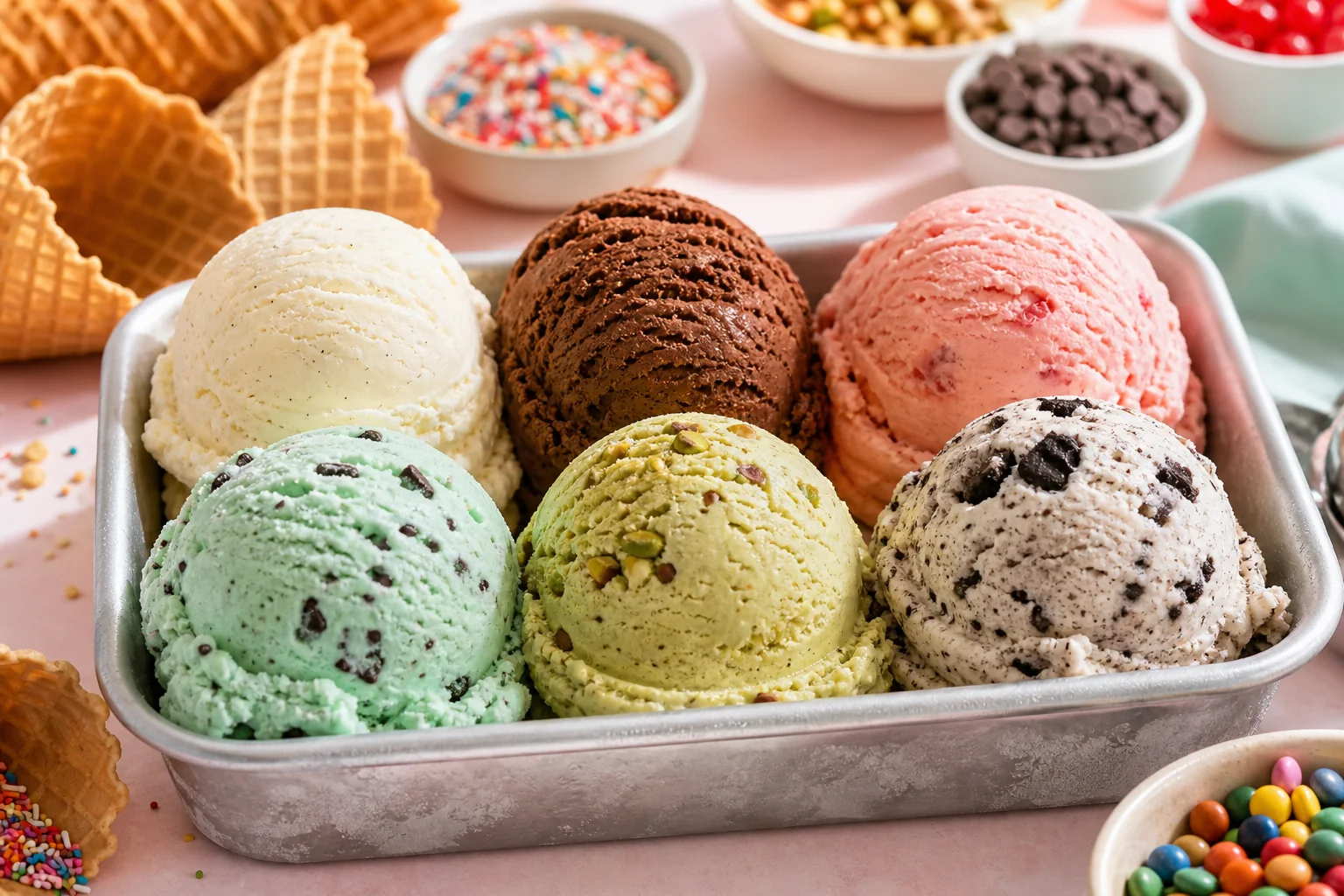
- Mint chip is a texture trick. The flavor is refreshing, but the thin chocolate pieces also add contrast that makes each bite feel more active.
- Neapolitan solves the decision problem. Chocolate, vanilla, and strawberry in one package make a simple dessert feel like a sampler.
- Cookies and cream is built on contrast. Smooth base plus crumbly cookie pieces gives the brain more to notice than a one-texture scoop.
- Fruit flavors need balance. Fruit brings water and acidity, so a good fruit ice cream has to manage brightness without becoming icy.
- Nut flavors often taste warm even when frozen. Pistachio, hazelnut, pecan, and peanut bring roasted notes that read cozy against cold dairy.
- Salted caramel works because of contrast. Salt sharpens sweetness and makes caramel taste deeper rather than simply sugary.
- Regional frozen desserts expand the map. Kulfi, gelato, granita, paletas, dondurma, and mochi ice cream show that frozen dessert culture is not one-size-fits-all.
- Soft serve is about immediacy. It is dispensed fresh at a softer texture, which makes the swirl feel distinct from a hard-packed scoop.
- Toppings change the eating speed. Crunch, sauce, fruit, whipped cream, and nuts slow the rhythm of a bowl and turn a scoop into a composed dessert.
- The best flavor is contextual. A beach-day cone, a birthday cake scoop, and a winter brownie sundae can each have a different winner.
Cone, Truck & Parlor Facts
Ice cream is not only what is in the bowl. The vessel, the counter, the truck window, and the first lick all shape the experience.
The cone changes the whole dessert.
A cone adds crunch, aroma, portability, and a built-in ending. It also changes how fast the ice cream melts onto your hand, which is part of the drama.
Read the cone guideCake cones
Light, crisp, and mild, usually letting the flavor of the scoop stay in front.
Sugar cones
Sturdier and sweeter, with a deeper toasted note than a cake cone.
Waffle cones
Big aroma, crisp edges, and a fresh-baked personality when made well.
Ice cream trucks
Part dessert stand, part neighborhood signal, part warm-weather memory machine.
Ice Cream Myths vs. The Better Scoop
Fun trivia gets even better when it cleans up the myths without flattening the joy.
| Common Claim | The Better Scoop | Why It Matters |
|---|---|---|
| One person definitely invented the ice cream cone. | Several people are credited, especially around the 1904 St. Louis World's Fair. | The cone is a great example of an idea becoming popular through culture, timing, and many makers. |
| Thomas Jefferson brought ice cream to America. | Ice cream was already known in colonial America, but Jefferson's recipe is an important early American record. | It gives Jefferson a real place in the story without repeating a false shortcut. |
| Ice cream is just frozen cream. | It is a balanced system of dairy or other base ingredients, sweetener, water, fat, air, ice crystals, and temperature. | That explains why small formula changes can make a scoop icier, softer, denser, or smoother. |
| Freezer burn means ice cream is unsafe. | Freezer burn is usually a quality issue, not automatically a safety issue, though spoiled or mishandled food should be discarded. | It helps readers understand why storage affects enjoyment even when a product is still frozen. |
| Brain freeze means your brain is freezing. | The brain is not freezing. The pain is a short cold-stimulus headache triggered by cold contact in the mouth. | It turns a weird sensation into a memorable science fact. |
Try These Tiny Ice Cream Experiments
These are simple observation prompts, not complicated recipes. They make the facts easier to taste.
The soften test
Taste a tiny spoonful straight from the freezer, then another after a few minutes of softening. Notice how aroma, sweetness, and texture change.
The topping contrast test
Try one bite plain, one with sauce, and one with crunch. The flavor may be the same, but the eating experience changes.
The cone aroma test
Smell a cake cone, sugar cone, and waffle cone before adding ice cream. Toasty aroma is a big part of why cones feel like more than a container.
The fast-freeze thought experiment
Think about why homemade ice cream benefits from a cold base and a cold machine. Faster freezing can help keep ice crystals smaller.
The pairing test
Pair vanilla with pie, coffee with chocolate cake, and strawberry with shortbread. The best scoop may be the one that helps the dessert around it.
The storage check
Compare ice cream stored near the freezer door with ice cream stored deeper inside. Temperature swings are not kind to texture.
Ice Cream Fun Facts FAQ
Short answers for readers, preview snippets, and anyone who wants the scoop without a long scroll.
What is a fun fact about ice cream?
Air is one of the most surprising parts of ice cream. Churning adds air, which helps create a scoopable texture instead of a dense frozen block.
Why is ice cream creamy?
Creaminess comes from a balance of fat, sugar, milk solids, air, water, stabilizing ingredients, freezing speed, and tiny ice crystals.
What is brain freeze?
Brain freeze is a short cold-stimulus headache that can happen when very cold food or drink chills the palate quickly.
Is frozen custard the same as ice cream?
They are closely related, but U.S. federal rules distinguish frozen custard by egg yolk solids. Texture and serving style can also differ.
Who invented the ice cream cone?
There is no single undisputed inventor. Several claimants are tied to the 1904 St. Louis World's Fair, where edible cones became famous in the United States.
Why does ice cream get icy in the freezer?
Icy texture often comes from temperature swings, partial thawing and refreezing, water balance, or air exposure that encourages large ice crystals.
Fact-Check Trail
Editorial note: Chilly Scoops keeps trivia playful, but the specific dates and regulatory details on this page were checked against reliable references. World records, annual flavor rankings, and brand-specific claims change often, so this page avoids brittle record claims unless they can be refreshed.
More to Explore
History of Ice Cream
How frozen desserts evolved through culture and technology.
The Science of Ice Cream
Fat, sugar, air, temperature, and ice crystals.
Types of Ice Cream
A guide to ice cream, gelato, custard, sorbet, kulfi, and more.
Ice Cream Cones
Cone styles, bowls, storage tips, and pairing notes.
Ice Cream Pairings
Match flavors with pies, brownies, cookies, coffee, fruit, and cake.
Unusual Flavors Around the World
A respectful look at regional and modern flavor inspiration.